
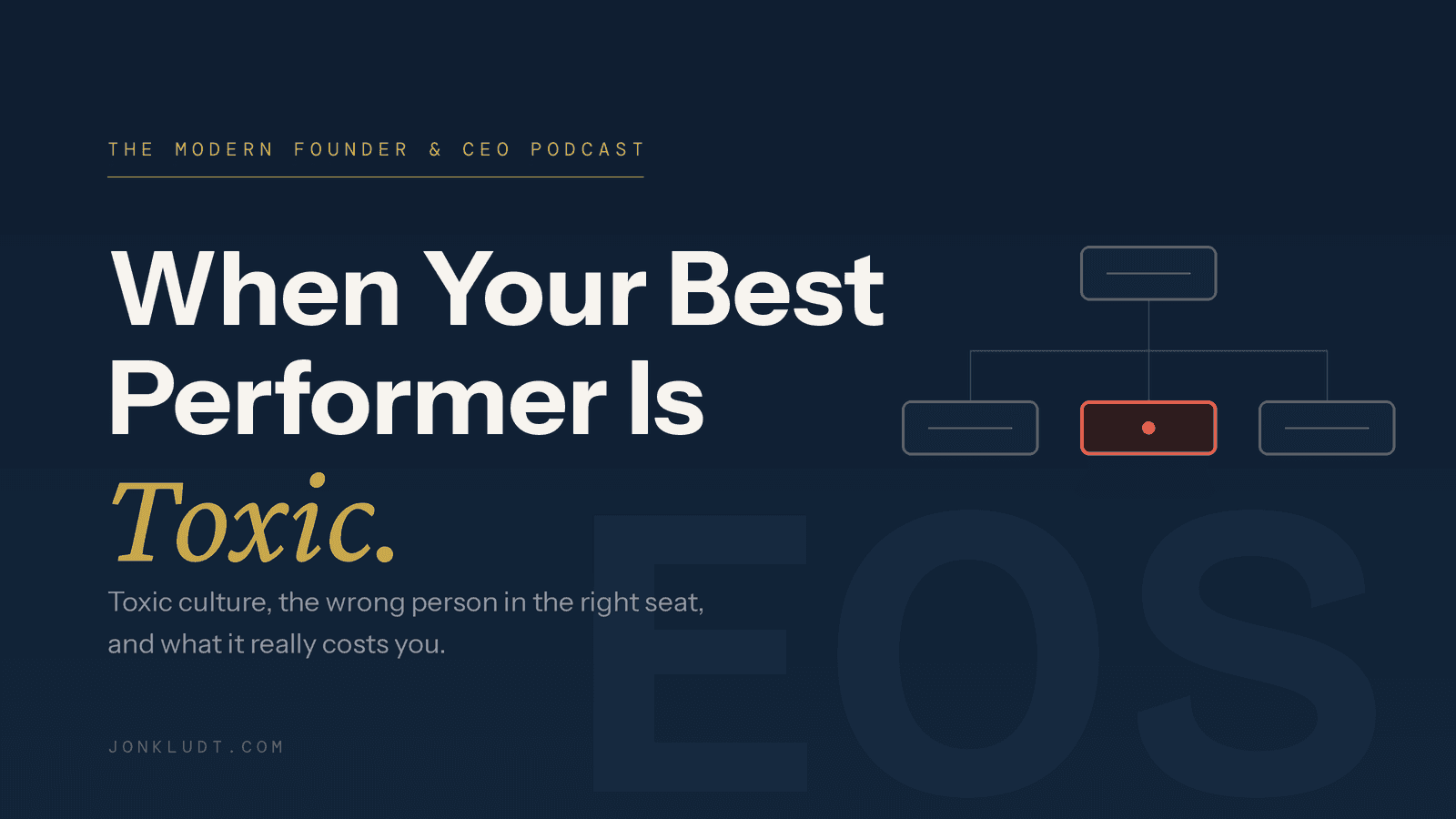
Every leadership team I sit with has at least one. The person who hits their numbers, closes the deals, ships the work — and leaves a trail of demoralized people behind them. Everyone knows who it is. Nobody wants to touch it, because the results are too good to risk.
That tension sat at the heart of my conversation with Catherine Mattice on The Modern Founder & CEO Podcast. Catherine is the CEO of Civility Partners, and she has spent her career helping organizations clean up toxic work environments. What struck me most wasn't the horror stories — it was how ordinary the problem is, and how much it quietly costs businesses that look perfectly healthy from the outside.
Toxic behavior is a business problem, not an HR footnote
It's tempting to file “culture” under soft stuff — something to get to once the real work is done. Catherine's point lands harder than that: toxic behavior and workplace bullying tax the two things every founder actually cares about — productivity and retention.
When someone is difficult to work with, the people around them disengage. They stop volunteering ideas. They route around the problem instead of through it. The best people — the ones with options — leave first. And by the time the cost finally shows up in your numbers, it has been compounding for quarters.
The damage from a toxic high performer is rarely loud. It shows up as the good people who quietly stop trying — and then quietly leave.
The “wrong person in the right seat” trap
Here is where Catherine's world and the EOS® world meet. In EOS, we talk constantly about getting the Right Person in the Right Seat. The “right seat” means someone Gets it, Wants it, and has the Capacity to do the job — GWC™. The “right person” means they genuinely live your core values.
A toxic high performer is the textbook case of a right seat with the wrong person. They clearly Get it, Want it, and have the Capacity — that's exactly why the results are there. But they don't share your values. And because the seat is filled so capably, leaders talk themselves into believing the values gap is a rounding error they can manage around.
It isn't. The whole promise of an Accountability Chart is that every seat is owned by someone the rest of the team can trust to behave like a teammate. One values violator in a key seat doesn't just underperform on values — they give everyone else permission to lower the bar.
Culture is set at the top — including by you
Another of Catherine's themes I keep coming back to: a leader's own behavior shapes the environment far more than any policy or poster on the wall. Toxic cultures are rarely the work of one bad apple in a vacuum. They grow wherever leadership tolerates, models, or rewards the behavior.
That's an uncomfortable mirror for founders. The question isn't only “who on my team is toxic?” It's also “what am I tolerating, and what am I modeling when I'm stressed, stretched, and behind?”
You can't lead well on empty
The most personal thread of our conversation was the last one. Catherine talked about her own growth as a leader, and how delegation, self-care, and real relationships aren't indulgences — they're prerequisites. A depleted founder is a short-tempered founder. A short-tempered founder sets a tense tone, and a tense tone is fertile ground for the exact behaviors you're trying to root out.
That's the same truth sitting underneath everything I do with EOS: when the founder is the bottleneck — doing too much, holding too much — the whole system runs hot. Health at the top is what makes a healthy culture possible everywhere else.
What to do this quarter
If a specific name came to mind while you were reading this, here's where I'd start:
Name it honestly. Run the person through the People Analyzer™ against your core values — not their results. If they're a consistent minus on the values that matter most, you have a right-person problem, not a performance one.
Have the direct conversation. Most toxic behavior survives because no one in authority has ever clearly named it and asked for change. Give them a real, specific chance to course-correct before you decide anything.
Take it to your Level 10 and IDS it. Don't let it live in hallway conversations. Identify the issue, Discuss it as a leadership team, and Solve it — with an owner and a timeline.
Check your own tone first. Before you address anyone else, ask honestly whether your behavior under pressure is part of the soil this grew in.
Protecting your culture from a single talented, corrosive person is one of the hardest things a founder will ever do — because the short-term math always argues for keeping them. Catherine's work, and everything I've seen across hundreds of leadership sessions, says the long-term math runs the other way. The team you keep is worth far more than the one person you're afraid to lose.
Listen to the full conversation with Catherine Mattice on The Modern Founder & CEO Podcast here — and if you're staring at a “right seat, wrong person” decision right now, that's exactly the kind of thing a focused leadership session is built to work through.