
EOS® for Dental Laboratories
EOS® for Dental Laboratories
Dental labs win on fit, turnaround, and service — and lose margin one remake at a time. EOS® gives lab owners a leadership team, weekly numbers, and a rhythm that doesn't depend on the owner touching every case.
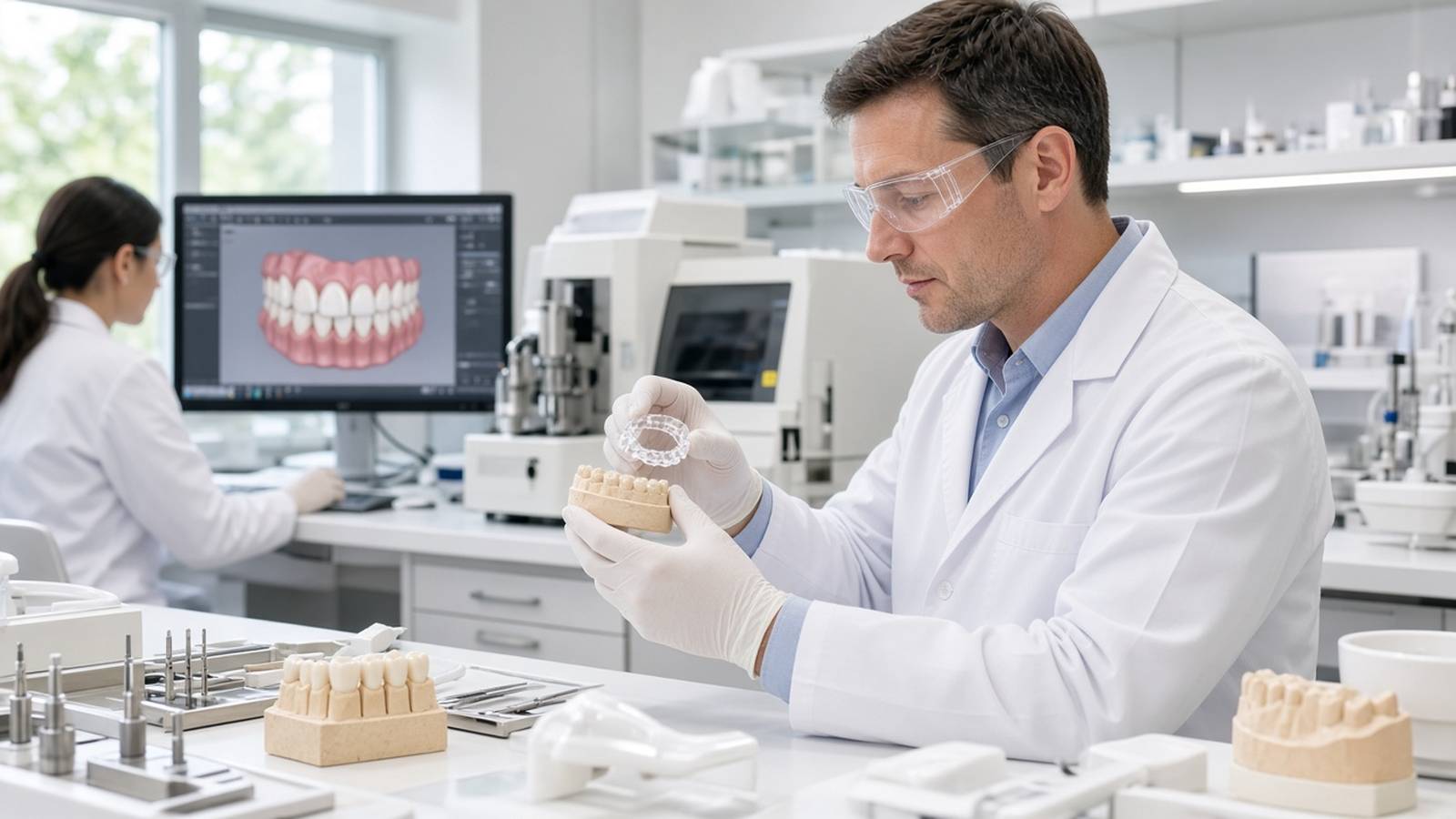
Most dental labs are built by a great technician. The owner knows materials, knows which dentists are particular about contacts and shade, and can rescue a case that's gone sideways. Clients stay because of that craftsmanship and service. But as the lab grows, the owner ends up as the head of production, the chief troubleshooter on every difficult case, the salesperson, and the person who signs the checks — and the lab's capacity tops out at their calendar.
The industry is also changing fast. The number of U.S. dental labs fell below 5,000 at the start of 2025, the 20th straight year of contraction, and lab employment hit a record low of about 41,500 in 2024 — fewer labs and fewer people doing more of the work. Wages in the industry rose about 25% in the four years before 2025, while lab prices didn't come close to keeping up. Digital workflows, intraoral scans, milling, and printing have lowered direct labor for many labs but raised material costs. The labs doing well are the ones that know their gross margin, remakes, and turnaround every week.
The Entrepreneurial Operating System® fits dental labs because the work is already a production process with measurable steps. What's usually missing is the layer above the bench: one owner per function, a weekly Scorecard, and a leadership meeting where issues get solved instead of recycled. Jon Kludt, a Certified EOS Implementer® with 350 sessions facilitated, works with founder-led companies of roughly 10–250 people across a wide range of industries — and the EOS® toolset is industry-agnostic by design.
Sound familiar?
- The owner is still the best technician, the case troubleshooter, the salesperson, and the CEO — and the CEO job gets whatever time is left.
- Remakes and adjustments eat margin, and nobody tracks internal remakes or their root causes.
- Turnaround slips when one key technician is out, because the know-how lives in a few people's heads.
- Prices haven't kept up with wages and materials, and nobody owns a regular pricing review.
- A handful of large accounts drive most of the revenue, and losing one would hurt badly.
- Hiring and training technicians takes months, and good people leave for labs with clearer career paths.
An example Dental Labs Accountability Chart
A dental lab's chart reflects its core engines: winning and keeping dental clients, producing high-quality cases on time, and running the business behind the bench. Here's a typical chart for an owner-led lab of roughly 10–100 people. Seats, not people; in a smaller lab one person may hold two seats, but every seat needs exactly one owner.
Visionary
- Lab vision, mission, and core values
- Key dentist, DSO, and specialist relationships
- New product lines, materials, and technology bets
- Big problem solving and clinical reputation
Integrator
- Lead, manage, hold accountable (LMA) across the leadership team
- P&L ownership and business plan execution
- Resolve issues between sales, production, and client service
- Run the meeting pulse and keep the V/TO™ and Rocks on track
Sales & Client Relationships
- Revenue target, new accounts, and client retention
- Dentist education, study clubs, and lunch-and-learns
- Pricing, product mix, and client concentration
- Marketing and digital-scanner partnerships
Production
- LMA for technicians, designers, and department leads
- Turnaround time and on-time shipping
- Remakes, quality control, and root-cause reviews
- Capacity planning, equipment, and materials usage
Client Service & Case Management
- Case intake, prescriptions, and scan/impression review
- Proactive communication with dental offices on case issues
- Shipping, pickups, and delivery
- Client feedback and complaint resolution
Finance & Admin
- Accurate, on-time financials and gross margin by product line
- Billing, collections, and cash flow
- HR administration, recruiting support, and training records
- Compliance, IT, and facilities
Seats, not people — one person can hold more than one seat in a growing company. The chart defines the structure the business needs, then you put the right people in the right seats.
Setting your V/TO™ numbers: what healthy looks like
A dental lab's V/TO™ needs numbers that reflect how the lab actually makes money: net profit, direct labor, materials, and the revenue each technician produces. Here's what the published data says so your 3-year picture is ambitious and real.
Net profit
Historically ~10–12%; over half of NADL 2025 respondents above 15%
Industry writers who review lab financials put historical net profit at around 10–12%. In the NADL's 2025 business survey, more than half of responding labs reported net profit above 15% — so 15%+ is a realistic target for a well-run lab. (FDLA Focus, Q1 2026 — Travis Zick, 'Navigating the Challenges and Managing for Success in Today's Dental Market')
Direct labor + materials
~60% of sales traditionally
Direct labor and materials are the two biggest production costs and have traditionally run around 60% of sales. They're variable, so they can be managed weekly when volume rises or falls. (FDLA Focus, Q1 2020 — Travis Zick, 'Managing for Profitability')
Direct labor as % of sales
Approaching 40% traditional; low 30s or less in digital labs
Digital workflows, monolithic materials, and milling have cut direct labor in many labs. A fixed or implant-heavy lab should run a lower labor percentage than a removable lab. (FDLA Focus, Q1 2020 — Travis Zick, 'Managing for Profitability')
Materials as % of sales
~20% traditional goal; low-to-mid 20s today
Material costs have risen in the digital era — zirconia waste can't be refined and recaptured the way alloys could. Materials running high is often a sign of internal remakes or wasted material. (FDLA Focus, Q1 2020 — Travis Zick, 'Managing for Profitability')
Industry size and lab size
~4,900 labs; ~8.6 employees per lab (2024)
BLS data show 4,944 private dental labs in 2024 (down from 6,764 in 2014), with average size rising from 6.5 to 8.6 employees per lab. The industry is consolidating into fewer, larger labs — scale and systems matter more every year. (Elegant Dental Lab — US Dental Labs by the Numbers (analysis of BLS QCEW data))
A weekly Dental Labs Scorecard that actually predicts
A dental lab Scorecard works when it's weekly, owned seat by seat, and predictive. Monthly financials tell you what already happened; these numbers tell you what's coming while there's still time to fix it.
| Measurable | Example target | Why it's on the Scorecard |
|---|---|---|
| Cases received (new and from existing clients) | Set from baseline | The top of the funnel. A drop from a key account shows up here weeks before it shows up in revenue. |
| On-time shipping % | ≥ 98% | Dentists schedule patients around your delivery date. Late cases cost the office chair time and cost the lab trust. |
| Remake rate (internal and external) | Set from baseline, trending down | Every remake is labor and material spent twice. Tracking internal remakes, not just client returns, is where most labs find hidden margin. |
| Direct labor % of sales | ≤ firm target (e.g., low 30s for a digital fixed lab) | Labor is the largest cost in the lab. A weekly view catches overtime and slow periods before they hit the monthly P&L. |
| Materials % of sales | ≤ firm target (e.g., low-to-mid 20s) | A rising materials number usually points to remakes, failed mill or print cycles, or waste — all fixable once they're visible. |
| Revenue per technician | Set from baseline, trending up | Low revenue per technician usually means high direct labor and low gross margin. It's the clearest productivity number in the lab. |
| New accounts opened / accounts lost | Net positive monthly | Client churn is quiet in a lab — offices just stop sending cases. Watching both numbers weekly keeps retention on the agenda. |
| AR over 60 days | Set from baseline, trending down | Labs carry dental offices on credit. Slow payers turn a profitable month into a cash crunch. |
Example quarterly Rocks
Rocks are the 3–7 most important things the lab must get done in the next 90 days, each with one owner and a clear definition of done. Typical examples for dental lab leadership teams:
- 1Start tracking internal and external remakes by cause, with a weekly root-cause review in the Level 10 Meeting™
- 2Complete a pricing review against current labor and material costs and roll out new pricing to all accounts
- 3Document the case intake and scan-review checklist so problem cases are caught before production
- 4Cross-train two technicians on the lab's highest-volume product so turnaround doesn't depend on one person
- 5Move the owner's top 10 dentist relationships to the sales seat, with joint visits completed
- 6Open 10 new accounts from a defined target list of practices
Guide download
Get the Dental Labs EOS® guide
The example Accountability Chart, benchmarks, Scorecard measurables, and Rocks from this page — on one branded PDF you can share with your leadership team.
From Jon's desk
Great craftsmanship built the lab. A system is what scales it.
Most dental labs start with a technician who is genuinely great at the work. Dentists notice. Cases fit, shades match, and when something goes wrong, the owner picks up the phone and fixes it. Referrals follow, and the lab grows.
Then the same strengths become the ceiling. The owner is still the best technician, the person who troubleshoots every difficult case, the main contact for the biggest accounts, and the person who runs the business. Turnaround depends on whether one or two key people are in that day. Remakes get fixed but never counted. Prices stay the same for years because nobody has time to review them.
The numbers make this risky. Lab wages rose about 25% in the four years before 2025, while prices didn't keep up. Direct labor and materials have traditionally eaten around 60% of sales. The industry has been shrinking for twenty years, with fewer labs doing more of the work. And yet, in the NADL's 2025 survey, more than half of responding labs reported net profit above 15% — proof that the gap between a struggling lab and a thriving one is mostly management, not market.
EOS® addresses this directly. The Accountability Chart separates sales and client relationships, production, client service, and finance — one name per seat. In most labs it shows the owner holding four seats. The Scorecard replaces 'we're busy' with real weekly numbers: cases in, on-time shipping, remakes, labor and materials percentages, revenue per technician, account gains and losses, and receivables. And the Level 10 Meeting™ gives the leadership team ninety minutes a week to solve the issues that keep coming back.
The craftsmanship doesn't change. Dentists still get the same quality. What changes is that the quality no longer depends on one person catching everything. Processes get written down, technicians get cross-trained, and the owner gets time to work on the business instead of only in it.
If the lab only runs well when you're at the bench, that isn't a talent problem or a market problem. It's an operating system problem — and it's fixable.
Frequently asked questions
We're a small lab. Is EOS® too much structure for us?
EOS® is built for entrepreneurial, owner-led companies, not big corporations. The tools are simple: one page for the vision, one chart for who owns what, a weekly Scorecard, and a weekly meeting. Smaller labs that plan to grow often get the most from it, because the habits are easier to build before the team gets large.
Our technicians need to be at the bench. Won't EOS® meetings take them away from production?
The weekly Level 10 Meeting™ is 90 minutes for the leadership team only — most technicians stay on production. What it replaces is the constant interruptions and hallway decisions that already pull leaders away from the bench.
We already have lab management software. What does EOS® add?
Lab software tracks cases; EOS® decides who acts on the numbers and when. Labs with good case data usually implement faster because the Scorecard numbers already exist. What's often missing is a leadership team that reviews them every week and holds each seat accountable.
Which dental labs is EOS® a fit for?
Owner-led dental laboratories — fixed, removable, implant, orthodontic, and sleep and oral appliance labs — typically companies of roughly 10–250 people. EOS® is industry-agnostic, and Jon works with founder-led companies across a wide range of industries.
What happens on the first call?
It's a 30-minute call about your team and what's getting in the way. You leave with practical tools you can use, whether or not we work together.
What does it cost?
Jon will go over that on the call, based on the size of your team and how many sessions you'd do.
A business coach for leadership teams in dental labs
If you've been searching for a business coach who understands dental labs, here's the honest difference with EOS®: instead of generic advice, you get a complete operating system — installed by a world-class business coach and Certified EOS Implementer® — that starts from your numbers, your seats, and your 90-day priorities.
Jon Kludt has facilitated 350 sessions with founder-led leadership teams across a wide range of industries. The system is industry-agnostic by design; pages like this one exist so you can see it translated into your world before you ever book a call.
Benchmark sources
- FDLA Focus, Q1 2026 — Travis Zick, 'Navigating the Challenges and Managing for Success in Today's Dental Market'
- FDLA Focus, Q1 2020 — Travis Zick, 'Managing for Profitability'
- Elegant Dental Lab — US Dental Labs by the Numbers (analysis of BLS QCEW data)
- U.S. Census Bureau via FRED — Dental Laboratories: Employees (NAICS 339116)
What leadership teams say about working with Jon
“EOS has completely changed my life. I used to be an over-stressed centralized operator of every decision, problem, option, and solution inside my business. Now I’m a decentralized owner of my business who enjoys owning a business that runs itself. The freedom to live, put my family first, and work ON my business, instead of in it, has given me peace and freedom I never thought possible. I work on my business when and how I want to, while I enjoy knowing it’s firing on all cylinders without my daily management or my time. EOS not only gave me life back, but my business has never been more successful; it’s on a growth trajectory that makes all my wildest dreams well within reach. Now I know it’s not if my business will achieve its goals, but simply when. And it’s such a fun experience to know that and watch it grow! ”
Nick Hooge
Owner of Freedom Boat Club, Seattle
“Jon has been a transformative coach for our leadership team. His ability to ask the right questions at the right time and guide us through real, lasting changes has been invaluable. We're more aligned, more accountable, and honestly — more excited about the business than we've been in years.”
Greg Grand
“Working with Jon has been one of the best investments we've made. He doesn't just teach a system — he coaches you through the hard conversations and holds you accountable. Our leadership team is stronger, our meetings are better, and we actually look forward to planning now.”
Peter Crabtree
Visionary of Crabtree Brands
Ready to run your business on EOS®?
Book a call. You'll leave with practical tools you can use right away — whether or not we work together.
Related industries